

TL;DR: The commission your delivery app advertises — 15% to 30% — isn't the number that actually leaves your bank account. Stack the processing fees, the promoted-listing charges, and the surge contributions on top, and the effective cost lands at 30% to 40% of the order total. Uber Eats raised its Marketplace fees again in March 2026. A restaurant running 50 delivery orders a week at a $45 average ticket is handing over roughly $29,000 a year in commission. The fix isn't rage-quitting the apps. It's using them to acquire customers and moving the repeat ones to a channel you own. Do that for even half your orders and you keep $12,000 to $14,000 a year in pure margin. Owning that channel used to require an agency. It doesn't anymore.
The headline rate is a magic trick
When a delivery platform quotes you "15% commission," look at what's not in the sentence.
Most restaurants pay somewhere between 15% and 30% commission per delivery order depending on the tier they signed up for. That's the number on the page. The number on your P&L is different, because the platform adds a payment-processing fee of roughly 2.9% to 3.5%, charges extra for the promoted placement you need just to be visible against the restaurant next door, and — during the exact dinner rushes when your volume spikes — asks you to "contribute" 5% to 15% toward delivery costs so the customer sees a lower fee.
Add it up and the effective cost of a third-party delivery order routinely reaches 30% to 40% of the total ticket. That's the consensus across the 2026 cost breakdowns from Rezku, ActiveMenus, and OPA. On a $45 order, you're not paying $6.75. You're often paying $13 to $18 before the food cost, the labor, and the packaging.
You already knew the apps were expensive. What's worth sitting with is how expensive, because the headline rate has trained a lot of good operators to underestimate the line by half.
The number that should be on your wall
Here's the math nobody puts in front of you when you sign up.
Take a restaurant doing 50 delivery orders a week — modest for a busy independent — at a $45 average ticket. At a 25% commission, that's roughly $29,000 a year flowing out the door to a platform, according to Rezku's 2026 analysis. Not revenue you never had. Revenue you earned, that touched your kitchen and your staff, and then left.
That $29,000 is bigger than a lot of the line items operators agonize over. It's bigger than most equipment financing. It rivals the fully loaded cost of a part-time hire. And for many independents it's larger than their entire annual marketing budget — which is the cruel irony, because the apps have quietly become the marketing budget, except you're renting the customers instead of keeping them.
March 2026 made it worse
This isn't a static problem you can budget around once and forget. In March 2026, Uber Eats raised its Marketplace fees again. The Lite tier moved up five points, and the Uber One member surcharge means a meaningful share of your repeat customers now effectively cost you 30% instead of 25%, per QSR Pro's breakdown of the change.
Read that twice: the platform raised the rate specifically on your loyal customers — the ones who order again and again. The people who should be your cheapest, highest-margin business are now your most expensive, because a third party owns the relationship and keeps re-charging you for access to it.
Every renewal cycle, the rate has one direction it tends to move. You are a price-taker on the single largest variable cost most delivery-heavy independents carry.
The mistake: rage-quitting the apps
So the answer is to drop off DoorDash and Uber Eats entirely, right?
For most restaurants, no — and this is where a lot of "just leave the apps" advice falls apart. The platforms are genuinely good at one thing: putting your restaurant in front of hungry people who have never heard of you. That discovery has real value, especially for a newer spot. Walking away from it cold can cost you more in lost first-time orders than you save in commission.
The operators who are actually winning in 2026 don't quit. They draw a line between two completely different jobs the apps are doing — and only pay full freight for one of them.
The move: rent acquisition, own the relationship
The pattern, repeated across every serious 2026 playbook on this (Rezku, ChowNow), is the same:
Use third-party platforms to acquire. Move repeat customers to a channel you own.
The apps are a customer-acquisition tool. Fine — pay the toll the first time, the way you'd pay for an ad. But the second order, and the third, and the hundredth, should not run back through a 30% pipe. Those should come through your own front door: your own ordering page, your own customer list, your own text or email reminding them you exist.
The difference is ownership. On the app, the customer belongs to the app. You don't get their email. You can't text them a Tuesday slow-night offer. You can't see that they always order the same thing and nudge them when it's back. You're a search result they rented you to. On a channel you own, that same person is your regular — and reaching them again costs you cents, not 30%.
What "owning the channel" actually requires
For years this is where the conversation died, because owning the channel meant hiring a web agency for the site, a separate company for online ordering, an email tool, a text tool, and someone to wire them all together. That stack cost more than the commission you were trying to escape. So most independents shrugged and kept paying the tax.
That math broke in your favor. The owned channel an independent needs in 2026 is a short list:
- A branded ordering page on your own domain, where a repeat customer can reorder in three taps and the full ticket is yours.
- A customer list you control — emails and phone numbers captured at the point of order — so reaching a past guest is a message, not a media buy.
- A way to show up locally — your Google Business Profile, your neighborhood visibility — so the discovery the apps charge you for, you increasingly do yourself.
- The glue that connects all of it without you logging into six dashboards.
This is exactly the consolidation KitchenRush was built to give independent operators: one platform that hands you a branded subdomain and ordering page, captures every customer into a list you own, manages your Google Business presence and local visibility, and runs your social and email from the same place — for a flat monthly cost that's a rounding error next to a single month of delivery commission. One platform replacing the five or six tools an agency would have charged you separately for. That's the point: the technology gap between the independents who own their digital presence and the ones still renting it is now wide enough to feel in your margin — and closing it no longer requires an enterprise budget.
The recoverable number
You don't have to move every order to win. You have to move the repeat ones.
Shift even half of those 50 weekly orders to a channel you own and you recover roughly $12,000 to $14,000 a year in pure margin — Rezku and ChowNow's figure, and it's pure because that money isn't fighting food cost or labor. It's commission you simply stop paying. That's a real raise for the business: a buffer against the next insurance hike, the capital for the patio build-out, the cushion that turns a break-even month into a profitable one.
The apps will keep raising the rent on customers you already earned. The only question that matters is how many of those customers you're willing to keep renting — and how many you're ready to finally own.
You built the relationship. You should be the one who keeps it.
Sources: Rezku (2026 third-party delivery fee analysis; "delivery tax" margin breakdown), QSR Pro (Uber Eats March 2026 Marketplace fee increase), ChowNow (direct online ordering vs. third-party dependence), ActiveMenus and OPA (true cost of third-party delivery), National Restaurant Association / Food Institute (2026 industry outlook and technology gap).
Visual version
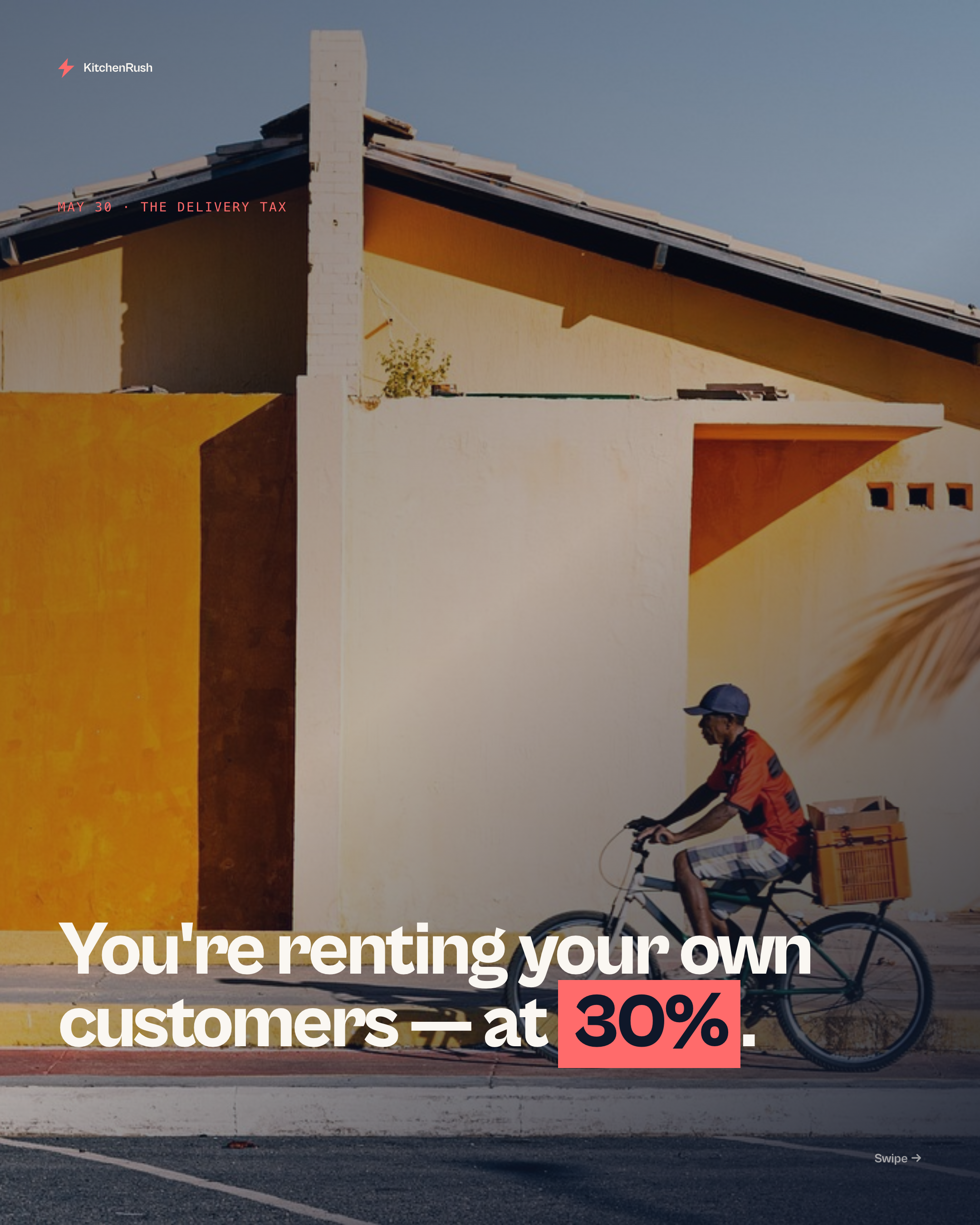
Carousel companion for the same topic.