

Direct ordering is usually sold to restaurant owners as a margin move: keep more of the order by sending guests to your own site instead of a third-party app. That is true, but it is incomplete. The bigger opportunity is retention.
A direct order gives a restaurant something a rented marketplace rarely gives cleanly: a relationship it can understand and act on. Who ordered? What did they choose? Was it pickup or delivery? Did they return? Did they leave a review? Did they later dine in? What would make them come back next week?
Those questions matter because the economics of independent restaurants are tighter than the generic growth playbook suggests. The National Restaurant Association expects 2026 industry sales to grow, but also warns that operators face persistent cost pressure, uneven traffic, and tighter consumer budgets (source). The James Beard Foundation and Deloitte 2026 independent restaurant reporting found that many operators are trying to make disciplined technology decisions while protecting margins; the same release notes that 40% of operators who implemented online ordering and delivery integration reported lower profits (source).
The lesson is simple: adding an ordering button is not enough. Direct ordering has to connect to guest data, local visibility, reviews, and follow-up.
The guest does not think in channels
Operators often organize the business by channel: dine-in, pickup, delivery, catering, reservation, review, social, email, SMS. Guests do not. They think in moments.
A guest might discover a restaurant on a map, watch a short video, order pickup on Tuesday, dine in on Saturday, leave a review, then order delivery two weeks later. If the restaurant sees those as separate events, it loses the relationship hiding inside the pattern.
DoorDash and SevenRooms highlight that modern guests move across delivery and dine-in while returning to places they know and trust. Their 2026 reporting also notes that familiarity drives repeat behavior: most dine-in visits and orders are with restaurants consumers have tried before (source).
That is a powerful signal for independent operators. The next visit often comes from someone who already gave you a chance. The job is to recognize that guest and make returning feel easy.
First-party data is operational memory
The phrase first-party data can sound like agency jargon. For a restaurant owner, it is simpler: it is the memory of the business.
It includes:
- Guest names and contact details collected with permission.
- Order history and visit patterns.
- Preferences, allergies, occasions, and favorite formats.
- Review history and sentiment.
- Response to offers, events, loyalty nudges, and menu launches.
- Whether a guest came through direct ordering, a marketplace, search, social, or in-person.
A small restaurant already has a version of this memory in the owner’s head, the host stand, the staff group chat, and the POS. The problem is that the memory is fragile. It disappears when the right person is off shift. It does not consistently trigger a follow-up. It does not always connect a pickup guest to a later review or dine-in visit.
The goal of direct ordering is to turn that memory into a system without making hospitality feel robotic.
Profit comes from relevance, not louder discounts
When traffic softens, the easy temptation is to discount broadly. That can bring short-term volume, but it can also train guests to wait for deals and reduce margin on visits that would have happened anyway.
A better retention system asks more specific questions:
- Who has ordered once but not returned?
- Who orders every Friday and might respond to a timely reminder?
- Who leaves positive feedback and should be invited to share a review?
- Who orders family meals, catering, or larger tickets?
- Who cares about dietary details or specific menu categories?
- Which guests should hear about a new item, event, or limited-time offer?
Personalized follow-up does not need to be complicated. It needs to be grounded in the guest’s actual behavior. The DoorDash 2026 release says 65% of consumers say a restaurant remembering their preferences would affect how often they choose that restaurant, and 63% say a personalized recommendation or follow-up prompted a return at least once in the past six months (source).
That is the retention opportunity: relevant outreach that respects the guest and protects the operator’s margin.
The direct-ordering loop
Direct ordering performs best when it is part of a loop, not a standalone checkout page.
A strong loop looks like this:
- Discovery: A guest finds the restaurant through maps, AI-assisted search, social content, reviews, or word of mouth.
- Confidence: The menu, photos, hours, reviews, and ordering path look current and trustworthy.
- Order: The guest orders directly or chooses a path where the restaurant can still learn from the interaction.
- Recognition: The restaurant captures permission-based contact and behavior signals.
- Follow-up: The guest receives a useful nudge tied to timing, preference, or occasion.
- Proof: Reviews, social activity, and repeat visits feed back into local discovery.
Every piece strengthens the next one. Discovery drives the first action. Direct ordering captures the relationship. Follow-up creates repeat demand. Reviews and content improve future discovery.
What independent operators should build first
Do not start with a complicated loyalty program. Start with the smallest system that creates a measurable return path.
A practical first version includes:
- A clean direct-ordering link from the website and Google Business Profile.
- A simple capture moment for email or phone number with permission.
- A review request after successful pickup or dine-in visits.
- A lapsed-guest segment for people who ordered once and did not return.
- A repeat-guest segment for people who should feel recognized.
- A weekly local post or email tied to real operations: new hours, menu updates, event nights, neighborhood moments, or seasonal offers.
The owner should be able to see whether the loop is working: direct orders, repeat orders, reviews, call volume, booking activity, and local profile engagement.
Where KitchenRush fits
KitchenRush is designed for independent restaurants that need the return path without managing a patchwork of disconnected tools. It brings direct demand, reviews, social content, local visibility, and guest follow-up into one operating rhythm.
The point is not to replace hospitality. The point is to make the restaurant’s hospitality easier to remember, repeat, and scale.
A direct order should not be the end of the transaction. It should be the beginning of the next visit.
Visual version
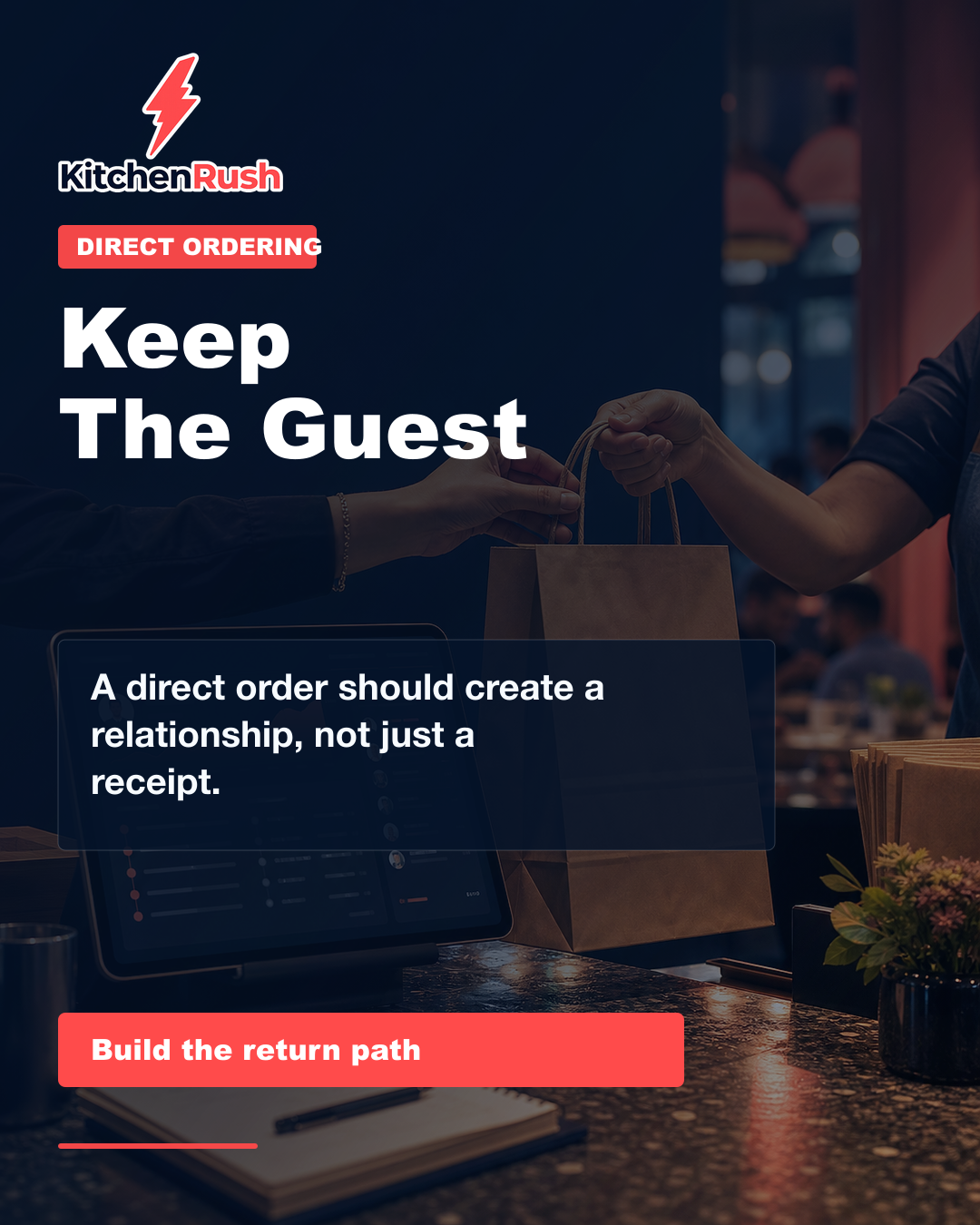
Carousel companion for the same topic.