

For independent restaurants, Google has never just been a search box. It is the place where a guest checks hours, scans photos, compares reviews, looks at the menu, asks for directions, and decides whether the restaurant feels worth the trip. In 2026, that decision path is getting even shorter.
Recent reporting found hidden strings in Google Maps for Android that point toward people asking Maps to order food, describe what they are craving, and let Maps help with the action. The feature is not live yet, and nobody outside Google knows the final shape. But the direction matters: discovery, recommendation, and ordering are moving closer together.
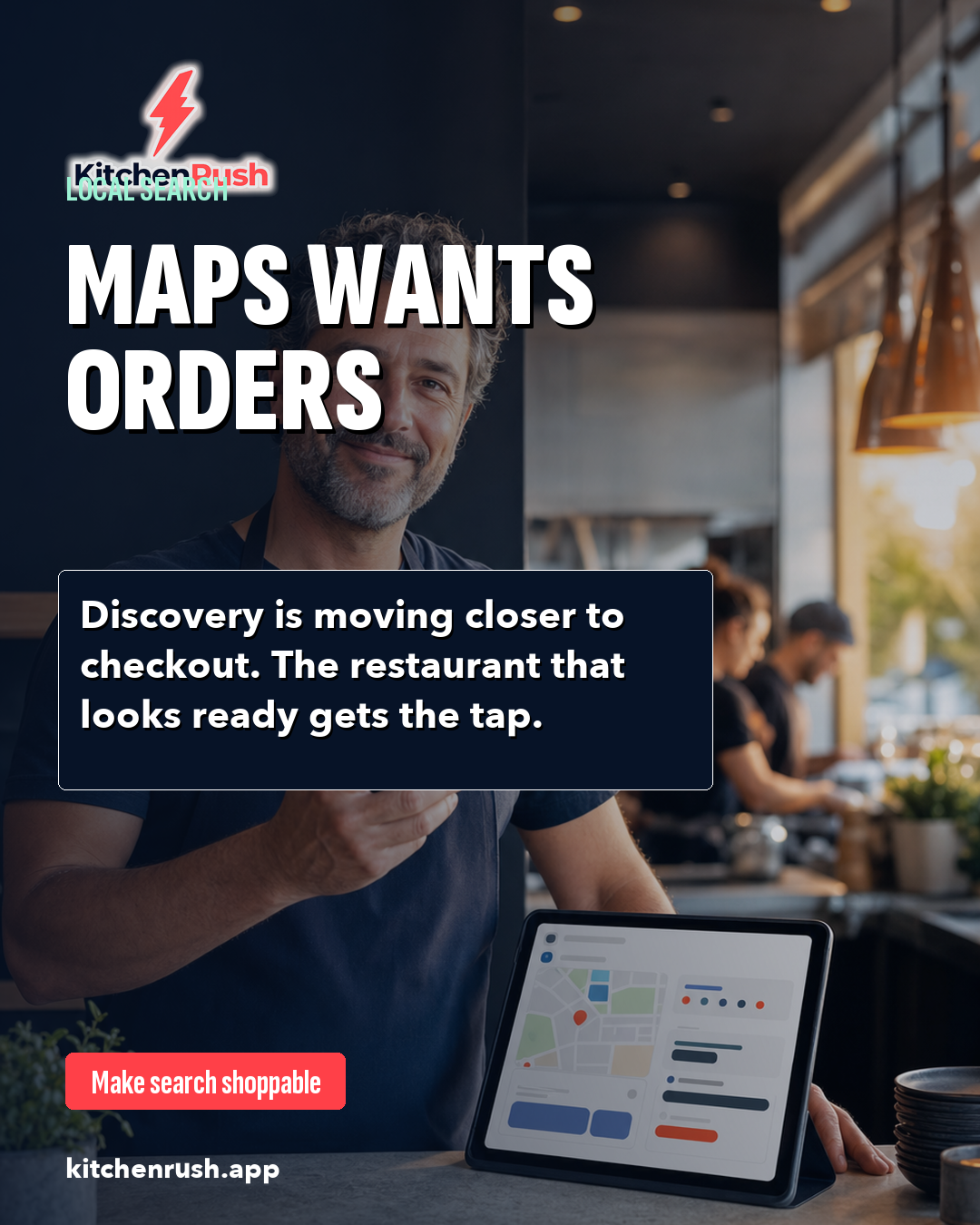
That should change how restaurant owners think about local marketing. The question is no longer, "Do we show up on Google?" The better question is, "When a hungry person sees us, does every signal make ordering easy?"
The local search page is becoming a checkout path
Most owners already know the Google Business Profile matters. The gap is that it is often managed like a listing instead of a revenue surface. Hours get updated only when something breaks. Photos are uploaded when someone remembers. Reviews get answered in bursts. Menu pages live in one system, ordering links in another, and social posts somewhere else.
That fragmentation used to be inconvenient. Now it is a conversion risk. If a guest is moving from a map result to an order decision in seconds, inconsistent data creates doubt. A missing holiday hour, stale menu item, old photo, weak review response, or hidden order link can be the small friction point that sends the guest somewhere else.
AI-powered discovery raises the stakes because these systems depend on structured, recent, trustworthy signals. Google does not just need to know that a restaurant exists. It needs confidence about what the restaurant offers, when it is open, whether guests trust it, what kind of occasion it fits, and where the next step should happen.
What operators should fix first
The strongest local growth system is not complicated. It is consistent.
Start with the data guests notice first: hours, address, phone, website, order links, and menu accuracy. Make sure the website, Google profile, ordering flow, and social bios all tell the same story. If a guest sees one set of hours on Google and another on the ordering page, the restaurant looks less reliable at the exact moment trust matters.
Then work on proof. Photos should show the current dining room, pickup experience, atmosphere, and guest-ready details. Reviews should not sit unanswered for weeks. Responses show that the business is active, and detailed review language can help modern discovery systems understand why people choose the restaurant.
Finally, make the direct order path obvious. If the guest is ready to act, do not make them hunt. A clean ordering link on the Google profile, a mobile-friendly menu, and a fast checkout path can keep more demand in the restaurant's own ecosystem.
The weekly operating rhythm
Most independent owners do not fail at local visibility because they disagree with the strategy. They fail because the work is scattered across too many tabs.
A practical weekly rhythm looks like this:
- Check profile accuracy before the week starts.
- Post one timely local update or offer.
- Add or rotate one strong visual.
- Answer recent reviews.
- Confirm the direct order path still works cleanly on mobile.
- Reuse that same update across social channels.
That is not a marketing stunt. It is maintenance on the front door. The difference is that the front door is now digital, mobile, and increasingly shaped by AI recommendations.
Where KitchenRush fits
KitchenRush is built for independent restaurant operators who do not have time to manage five disconnected marketing tools. The point is not to add another dashboard for the sake of software. The point is to bring local visibility, review management, social content, direct ordering signals, and neighborhood marketing into one operating rhythm.
When the system is connected, a restaurant can move faster. A weekday offer can become a Google update, a social post, and a direct ordering nudge. A strong review can inform the next caption. A menu change can be reflected consistently across the places guests check before ordering.
That is how small restaurants compete with chains that have corporate marketing teams. Not by outspending them, but by making the right local signals fresh, clear, and easy to act on.
The takeaway
If Maps, AI search, and ordering continue moving together, the winners will be the restaurants that look trustworthy and ready at the moment of intent. That does not require a massive campaign. It requires accurate data, fresh proof, clear ordering paths, and a weekly system the owner can actually maintain.
KitchenRush helps independent restaurants build that system so local search turns into direct demand instead of another missed tap.
Visual version
Carousel companion for the same topic.