

Independent restaurant owners do not lose demand only because guests choose a competitor. They also lose it in smaller, quieter ways: a call that rings during the dinner rush, a reservation question that waits too long in an inbox, a catering inquiry that needs a same-day answer, a delivery customer asking about a modifier, or a review that could have been turned into a return visit.
Those moments look operational, but they are also marketing moments. A guest who reaches out is already showing intent. They are closer to ordering than the person who only saw a post. The job is not to add another inbox or another dashboard. The job is to make sure every live demand signal turns into a next step before the guest disappears.
That is why AI phone answering, front-of-house automation, and unified guest communication are moving quickly in 2026. Recent restaurant technology reporting has highlighted voice and conversational AI across phone, SMS, app, kiosk, and drive-thru channels, while guest-management platforms are adding AI into reservations, waitlists, and seating flow. The signal is clear: operators need help capturing demand at the exact moment guests are ready to act.
For independent restaurants, the opportunity is not to sound bigger than they are. It is to stop letting high-intent guests fall through cracks that happen because the team is busy doing the work.
The rush creates invisible leakage
Most owners can feel the problem before they can measure it. The phone rings while the expo window is backed up. A host asks the kitchen a question. A manager is covering a station. A guest DMs the restaurant to ask if a table is open tonight. Someone emails about a group order for tomorrow. None of those signals are cold leads. They are demand already in motion.
But when each signal lives in a separate place, the business has to rely on memory. The phone has one history. Instagram has another. Google has another. Email has another. Reservation tools have another. A staff member may handle the question well, but the restaurant may not capture the guest, tag the request, remind the team, or follow up after the meal.
The leakage is not always a missed sale today. Sometimes it is a guest who never joins the restaurant's owned audience. Sometimes it is a catering lead that goes to the restaurant that answered fastest. Sometimes it is a review that never gets a response. Sometimes it is a regular who stops ordering because every interaction feels disconnected.
The fix starts by treating every guest touchpoint as part of one demand-capture loop.
What a demand-capture loop actually does
A demand-capture loop has four jobs.
First, it notices intent. Calls, DMs, web forms, reservations, Google messages, comments, reviews, and direct orders should not feel like disconnected chores. They are signals that someone is ready to choose, order, book, complain, praise, or ask.
Second, it routes the request. The team should know whether the guest needs a call back, a reservation confirmation, a menu answer, a catering quote, a review response, or a direct-order link. Routing is where automation helps without replacing hospitality.
Third, it gives the team a next action. A good system does not create more dashboards. It says, in plain language, what should happen next: confirm the table, send the ordering link, answer the allergy question, save the guest note, ask for the review, or follow up tomorrow.
Fourth, it learns what converted. If the restaurant captured a call, did it become an order? If a DM asked about a special, did the guest click through? If the restaurant posted a lunch offer, did the inquiries arrive before service or during service? That feedback loop is what turns marketing from guesswork into operations.
AI should reduce the operator's cognitive load
The temptation with AI is to talk about the tool instead of the outcome. Restaurant owners do not need AI for its own sake. They need fewer dropped balls during the busiest parts of the day.
The best restaurant AI should help with the practical work owners already recognize: answering common questions, summarizing guest requests, drafting responses, flagging urgent messages, capturing order intent, preparing callbacks, and reminding the team when a lead has not been handled.
That matters because independent operators do not have enterprise support teams. The owner may be the marketer, hiring manager, bookkeeper, customer service lead, and floor support in the same day. Every extra login creates a hidden tax. Every missed message creates risk. A well-designed demand-capture loop gives the owner a calmer way to stay responsive without hiring another person for every channel.
The phone is still part of digital marketing
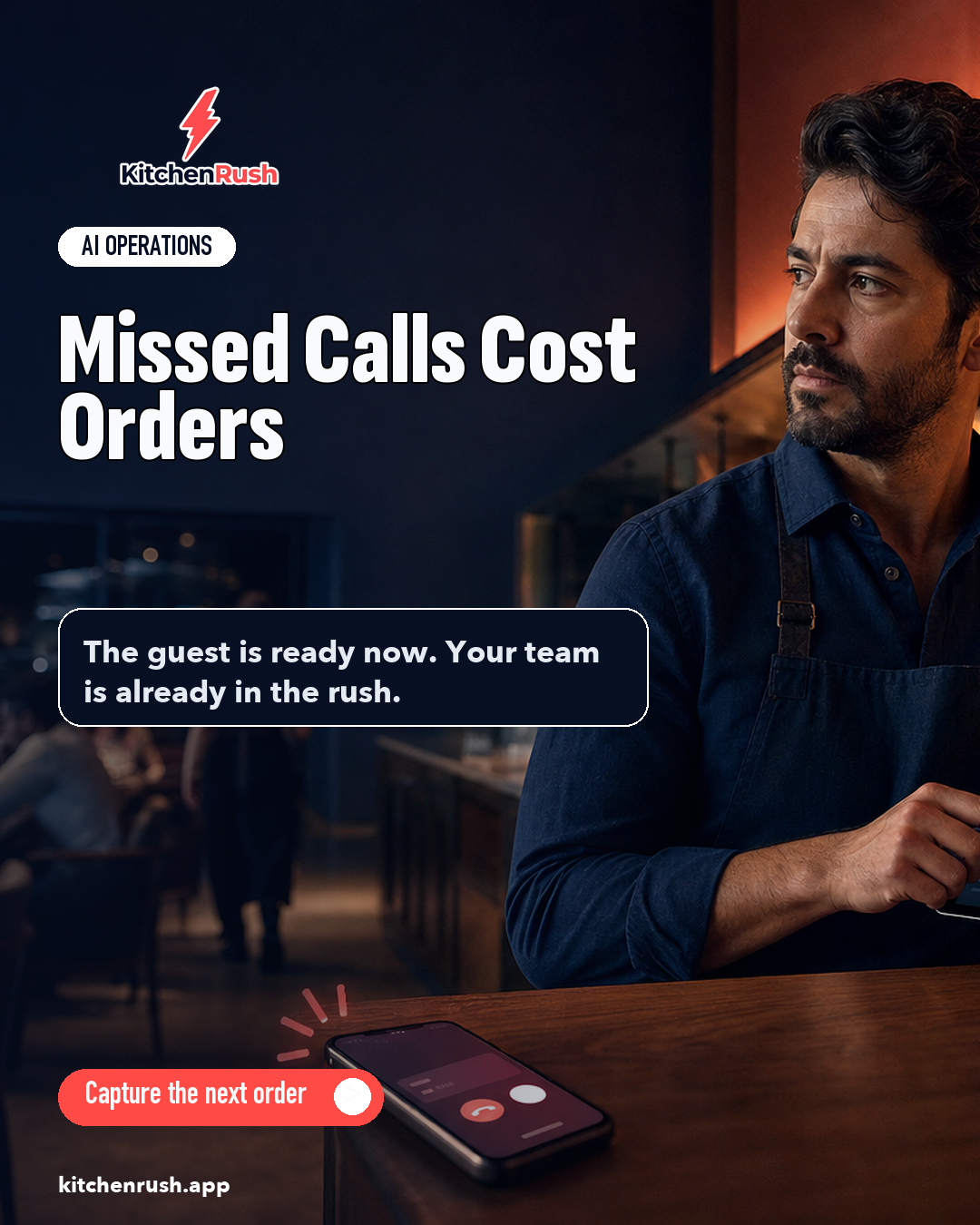
It is easy to think of restaurant marketing as posts, photos, offers, and ads. But a phone call is often the highest-intent conversion event a restaurant gets. A guest is asking for an answer now. A family wants to know whether the restaurant can seat six. A customer wants to order directly instead of using a marketplace. A local office wants catering. A regular wants to modify an order.
If that call goes unanswered, the restaurant may never know what demand was lost.
The same is true for messages. A restaurant can spend time and money getting attention, then lose the guest because the response path is slow. This is why demand capture belongs inside the marketing system, not beside it. Promotion, ordering, reviews, Google visibility, social messages, and follow-up should all feed the same operating view.
How independent restaurants can start this week
Start with one service window. Choose the period where the team misses the most demand signals: Friday dinner calls, weekday lunch inquiries, catering requests, or Sunday reservation questions.
List every channel that receives intent during that window. Include phone, website, Google Business Profile, Instagram, Facebook, email, reservation tools, and direct ordering.
Define three response categories: order now, book now, and follow up. Most guest requests fit into one of those lanes. The goal is not perfect automation. The goal is making the next action obvious.
Create a same-day follow-up habit. If a guest asked about a table, a special, a group meal, or a delivery question and did not convert, the team should know what to do next.
Finally, measure one outcome. Do not start with twenty metrics. Track calls captured, inquiries answered, catering leads responded to, or direct-order clicks recovered. Once the loop is visible, the restaurant can improve it.
Where KitchenRush fits
KitchenRush is built for independent restaurants that cannot afford to run marketing, ordering, local visibility, and guest communication as separate jobs. The platform helps operators bring demand signals into one workflow so the restaurant can respond faster, publish consistently, keep Google and social active, and turn guest attention into owned relationships.
The point is not to replace hospitality. The point is to protect it. When the system catches the routine work, the team can stay present with guests in the dining room.
Visual version
Carousel companion for the same topic.