

Food waste rarely announces itself as one large, obvious loss. It appears in smaller moments: a pan prepped for demand that never arrived, produce that aged out between deliveries, trim that could have been used elsewhere, or a plate that came back with the same side left untouched.
Each moment looks manageable on its own. Together, they can quietly absorb the margin an independent restaurant worked hard to earn. That is why the most useful food-waste system is not a complicated monthly spreadsheet. It is a short daily review that connects what left the kitchen to what the team will do differently tomorrow.
Seven minutes is enough to create that connection.
Why food waste is an operator priority in 2026
Independent restaurants are still managing elevated food and inventory costs while facing limits on how often they can raise prices. In TouchBistro’s 2026 independent-operator research, 42% of operators said they were prioritizing waste reduction as a cost-management response.
The direction is practical. Operators cannot control every supplier increase or demand fluctuation. They can control how quickly the business notices a repeat loss and changes the next prep, order, or portion decision.
Food-waste conversations are also becoming more operational. ReFED’s 2026 work highlights the growing role of data, forecasting, and AI in waste prevention. The important idea is not that every kitchen needs expensive hardware. It is that waste becomes easier to reduce once it becomes a visible operating signal.
The seven-minute review
Run the review after the final rush or before the next prep plan is locked. Keep it short enough that a manager can repeat it every day.
Minute 1: Name what left
Use simple categories: overprep, spoilage, trim, incorrect order, plate return, quality hold, or packaging and handling loss.
The purpose is not to create a complete accounting system on day one. The purpose is to stop all loss from looking the same. “Waste” is too broad to act on. “Two containers of overprepped garnish” points to a forecast or prep-par problem. “Four portions returned with the same side untouched” points to a guest-value or portion problem.
Minutes 2–3: Estimate the amount
Use the fastest unit the team can repeat reliably: portions, containers, pounds, ounces, estimated ingredient cost, or estimated selling value.
Consistency matters more than precision at the beginning. Choose one unit by category and keep it stable.
Minutes 4–5: Record the likely reason
Avoid blame. Ask what condition produced the loss.
Was demand lower than the prep forecast? Did a delivery arrive earlier than expected? Was a recipe yield inconsistent? Did one shift use a different portion? Was an item difficult to sell after a menu change?
Write the reason as a testable operating statement: “Tuesday prep par assumed weekend volume,” “two open containers were not dated,” or “portion tool changed between shifts.” This turns a discarded item into an operational clue.
Minute 6: Choose one correction
Do not build a ten-item action list. Choose the smallest change that can be tested on the next shift.
Examples include reducing one prep par by 10%, moving one ingredient to a first-use position, adding a date-and-time check to closing, standardizing one scoop or ladle, or changing one purchasing quantity before the next order.
One completed correction is more valuable than a long report nobody revisits.
Minute 7: Assign the next check
Name the person and time for the follow-up. “Kitchen manager checks the garnish container count after Tuesday dinner” is clear. “Watch waste” is not.
The review becomes a system when every adjustment has a next observation.
Review daily, decide weekly
Daily logs produce the signal. A weekly review finds the pattern.
Once a week, group the entries by reason and cost. Look for the top repeat loss, not the most dramatic single event. A one-time equipment failure may create a visible loss. A small portion inconsistency repeated across every service may cost more over a month.
Ask four questions:
- Which loss repeated most often?
- Which loss carried the highest ingredient cost?
- Which loss was easiest to prevent?
- Which correction actually reduced the next week’s result?
This creates a simple feedback loop: observe, adjust, verify, repeat.
Keep the culture constructive
Waste tracking fails when the team believes every entry will be used to assign blame. Restaurant teams make hundreds of decisions under time pressure. A useful system helps them see where the operating plan did not match reality. It does not punish someone for recording the truth.
Thank the person who records the loss. Discuss the process before the person. Separate unavoidable quality decisions from preventable process drift. Share the improvement when a correction works. Never encourage serving unsafe or substandard food to protect a metric.
The goal is not zero waste at any cost. The goal is better purchasing, prep, portion, and demand decisions without compromising food quality or safety.
Connect waste to the rest of the restaurant
Waste data becomes more useful when it is compared with daypart and order volume, menu-item mix, promotions and local events, weather, supplier substitutions, prep labor, comps, voids, and guest feedback.
An overprep pattern may be a forecasting issue. A repeated plate return may be a menu communication issue. Spoilage may be a purchasing cadence problem. The same number can point to a different action when the rest of the restaurant context is visible.
That is the operating advantage of a unified system: the owner can move from “we threw this away” to “here is what changed, why it changed, and what we will do next.”
What KitchenRush adds
KitchenRush is built to give independent restaurant owners enterprise-level operating visibility without forcing them to stitch together five or six separate tools.
The seven-minute review is useful on paper. It becomes more powerful when waste notes, menu performance, inventory signals, local demand, and the next marketing action can live in one operating flow.
The objective is simple: less time chasing disconnected information, more time making a clear decision.
Start tonight
Choose one station, one category, and one manager. Run the seven-minute review for seven days. At the end of the week, fix the most frequent preventable loss and measure the next seven days.
Small visibility creates better decisions. Better decisions protect margin.
Ready to connect your restaurant’s operating signals? Explore KitchenRush.
Visual version
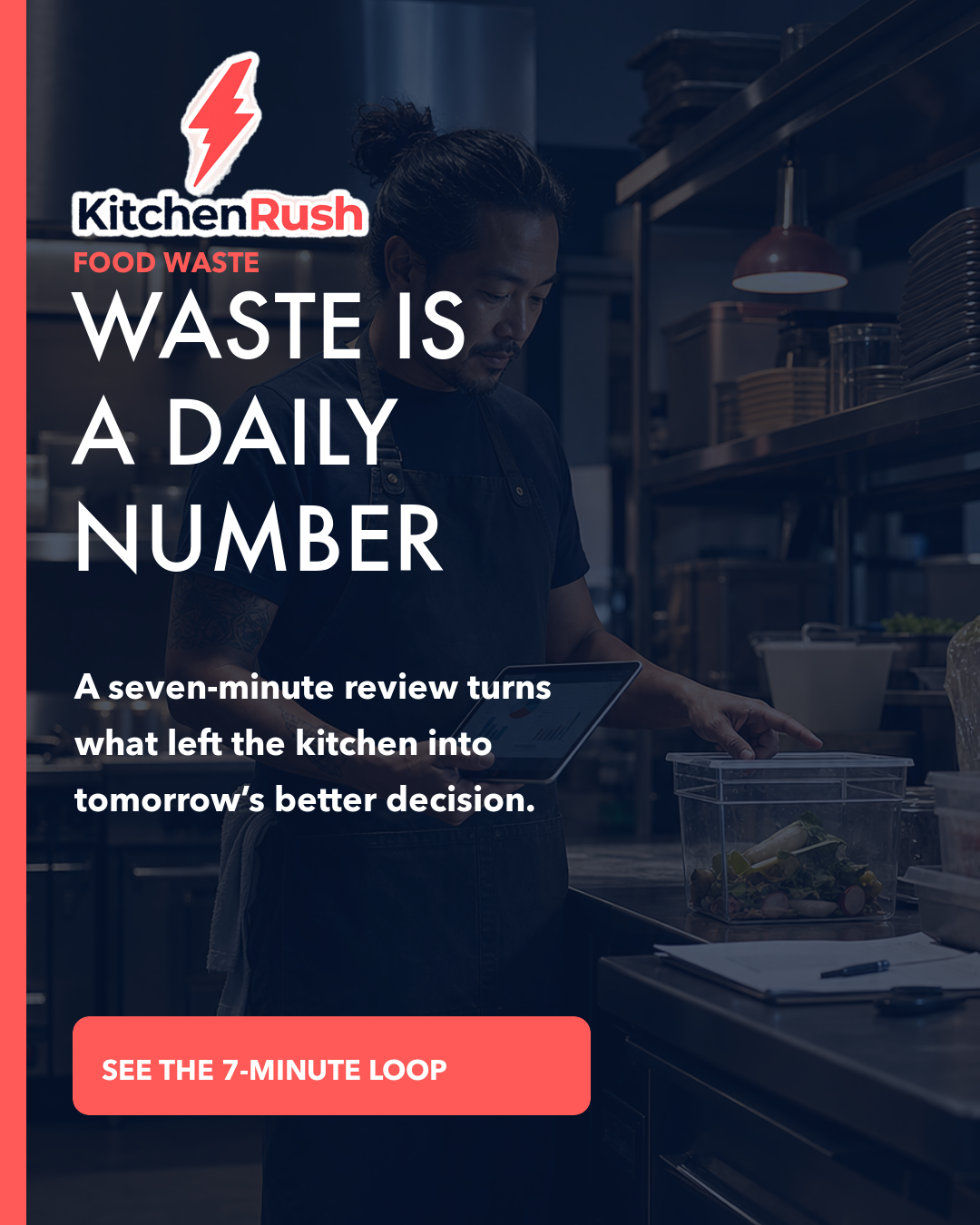
Carousel companion for the same topic.